India throws away 62 million tonnes of waste every year. A big chunk of that is exactly this — the bag that nobody thought about, the wrapper that got tossed, the packaging that had one job and then became someone else’s problem forever.It is about information. Specifically — which sustainable products are actually available in Indian homes right now, what they cost, what works, and what the fine print says before you buy anything.
There is a kirana shop near my aunt’s house in Kanpur. Been there since the 80s probably. Every time someone buys something — atta, namak, anything the shopkeeper reaches under the counter and pulls out a thin polythene bag. Just automatic. Nobody asks for it. Nobody refuses it. It just happens.
That polythene bag will be used for maybe fifteen minutes. It will exist for four hundred years.
What Sustainable Product Means When You Are Actually Shopping
Sustainable products. Eco friendly products. Green products. Natural products. These words are everywhere now and they mean different things depending on who is using them.
A sustainable product is something you use at home that causes less environmental damage than the conventional version it replaces. Less plastic. Less chemical runoff into drains and rivers. Less demand on forests. Either it breaks down naturally, or it can be reused multiple times, or it is made from materials that do not spend centuries in a landfill after you are done with them.
That is it. No lifestyle requirement. No income bracket. No Instagram aesthetic required.
Eco friendly products in the Indian market cover this ground now — kitchen, bathroom, cleaning, waste management. Five years ago finding these things meant ordering from small websites most people had not heard of, paying a significant premium, and hoping the product actually worked. That is not the situation in 2025. These are mainstream products on Amazon India, Flipkart, Meesho, in organic stores, in some supermarkets. Indian manufacturers. Indian pricing. Available to most households that want them.
The India Context: Why Sustainable products Is Not Just a Western Trend
Here is something that gets missed in conversations about sustainable products and eco friendly living in India.
India was already doing most of this.
The steel tiffin box — reusable, washable, used every day for decades. The cotton bag brought to the sabzi market. Kitchen waste composted in the backyard or fed to the building’s cows. The khaana ka kapda — a washable cloth for the kitchen that got laundered and reused. The dabbawala network in Mumbai, which is one of the most efficient zero-waste logistics systems on earth, has been running since the 1880s.
None of this needed a name. It was just how things were done.
What happened was not that India forgot how to live sustainably. What happened was that cheap plastic arrived very fast, regulation arrived very slowly, and urban convenience culture filled the gap in between. Single-use became the default not because anyone decided it should be but because it was cheaper, easier, and nobody was making it inconvenient yet.
The result shows up in the Ganga. The Yamuna. The drains that choke every monsoon — not because of rain but because of the accumulated polythene that was never going to go anywhere on its own.
Sustainable products in the Indian context are not an imported concept. They are a return to something that was already here, updated with materials and formats that fit how Indian households actually live now.
Bamboo — Why This Material Is Used in Many Sustainable Products
Before specific products, bamboo is worth a standalone explanation because the India connection is not incidental.
India has roughly 13 percent of global bamboo resources. Assam, Meghalaya, Manipur, Tripura — the northeast alone has extraordinary bamboo density. Maharashtra, Madhya Pradesh, Odisha. These are not small reserves. India is one of the largest bamboo-producing countries in the world and has been for a very long time.
Bamboo grows back in months after being cut. No replanting. No pesticides needed. Sequesters more carbon per hectare than most tree species. When an Indian household buys bamboo-based sustainable products, the raw material quite possibly came from Indian land and was processed by Indian workers. That is a supply chain that a lot of eco friendly products sold in India cannot honestly claim.
The material itself is also genuinely good for the applications it is used in. More absorbent than cotton. Naturally resistant to bacterial growth — relevant in Indian conditions where heat and humidity are not minor factors. Softer than wood pulp when processed into paper products. These are not marketing claims. They are observable material properties.
Sustainable Products for the Kitchen
Reusable Bamboo Kitchen Towels as Sustainable Products
The Indian kitchen had a perfectly good answer to this already. Cotton cloth. Washed, dried, reused. The khaana ka kapda was not a sustainability product — it was just the sensible thing that everyone did before disposable paper rolls arrived and convenience won.
Reusable bamboo kitchen towels are that same logic in a different material. Bamboo fibre absorbs better. Resists bacteria in a way cotton does not. Goes in a washing machine and comes out the same as before. A quality pack is rated for 80 to 100 washes — which covers roughly six to eight months of normal kitchen use before needing replacement.
One thing to check carefully when buying: the label needs to say washable and reusable explicitly. There are bamboo kitchen products that are still single-use — made from bamboo paper rather than bamboo cloth. These are better than conventional paper rolls in some ways but they are not the same product and they will not last through multiple washes. Check the packaging. Reusable versions specify the number of wash cycles. Single-use versions do not.
Compostable Garbage Bags as Sustainable Products for Waste Management
This category has regulatory context in India that not enough people know about.
The 2016 Solid Waste Management Rules started the formal process of moving away from conventional plastic garbage bags. State-level bans have followed — Maharashtra, Tamil Nadu, Karnataka all have active restrictions on single-use plastic bags below specified thickness. The direction of regulation here is not ambiguous.
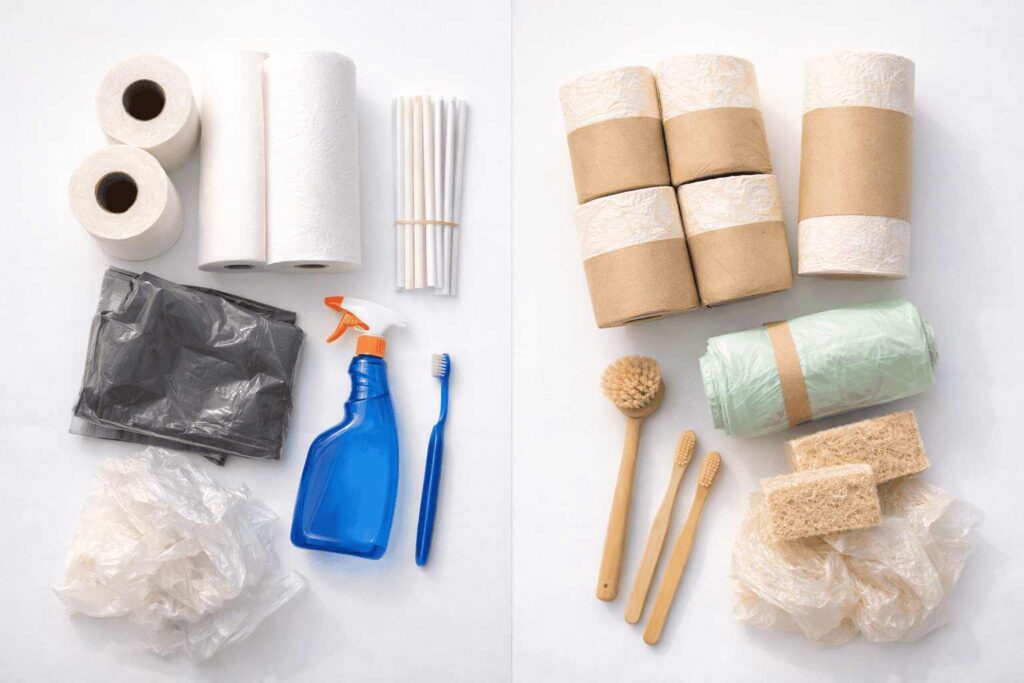
But here is where the language gets confusing. Biodegradable and compostable are not the same thing and brands in India use them interchangeably in ways that do not serve buyers.
Biodegradable garbage bags break down through microbial action. The timeframe can be anywhere from a few months to many years depending on conditions — landfill, open ground, compost. In India there is no regulated standard behind the word biodegradable on a product label. Any brand can print it on anything.
For Indian cities with municipal composting collection — Bengaluru, Pune, parts of Delhi — certified compostable bin bags are the ones that actually integrate properly with the composting system.
Do they hold up? The honest answer — good ones do, cheap ones do not. Material thickness and starch quality is everything in this category. Reading reviews specifically for how the bag performs with wet or heavy waste is the fastest way to find out before buying. Brands that work well do not hide this information.
Sustainable Products for the Bathroom
Bamboo Toilet Paper as a Sustainable Product
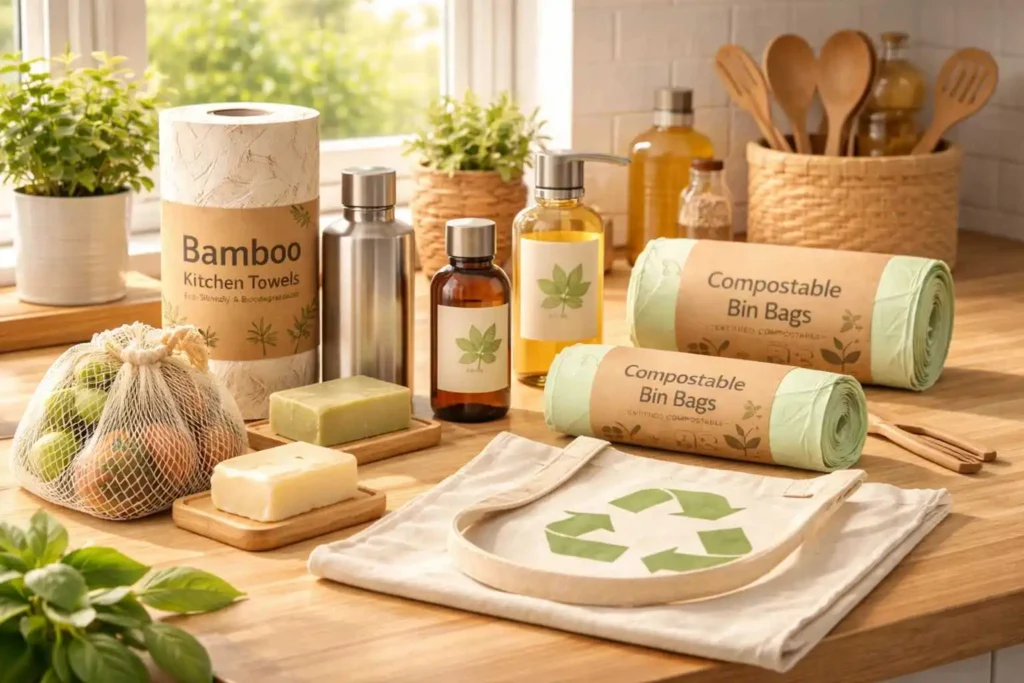
Conventional toilet paper in India is wood pulp. Trees that took 30 to 100 years to grow, cut to make something that lasts thirty seconds in use, processed with water and bleaching chemicals that end up in water systems as effluent.
Bamboo toilet paper is from a plant that regrows in months. Uses less water to process. Organic bamboo toilet paper skips the bleaching entirely. For Indian consumers dealing with skin sensitivity — very common in humid climates — the absence of bleaching agents and added fragrance matters in a way that is immediately noticeable.
Pricing on subscription or in larger pack sizes is now competitive with mid-range conventional toilet paper on a per-roll basis. This was not true three years ago. It is true now.
Bamboo Toothbrush as a Sustainable Product Alternative
India produces approximately 2.5 billion plastic toothbrushes annually. Almost none of them can be recycled through standard municipal systems — the bristles are too small for sorting equipment, the mixed materials cannot be separated. They end up in landfill and open dumps where they will outlast everyone reading this blog by several centuries.
A bamboo toothbrush replaces the handle — which is the largest material component — with biodegradable bamboo. It can go into organic waste or a compost bin. The nylon bristles need to be removed separately. Not a perfect solution for the bristle problem but a meaningful one for the handle, which is the bulk of the waste.
Brushes exactly like a plastic toothbrush. Priced comparably to Indian mid-range conventional brands. Takes about three days to stop noticing the slight difference in handle texture and then it becomes unremarkable.
Bamboo Cotton Buds as Everyday Sustainable Products
Coastal and river cleanup surveys in India find plastic-stemmed cotton buds consistently among the most recovered items. They are small enough to pass through every stage of waste sorting and end up in water bodies in numbers that are genuinely not small.
Bamboo cotton buds do the same job — cotton tips, identical size, identical use. The stem biodegrades in soil in months rather than persisting indefinitely. Available everywhere in India, priced at the same level or lower than plastic-stemmed versions in standard pack sizes. There is no meaningful practical trade-off here.
Eco Friendly Tissues as Sustainable Products for Daily Use
Conventional tissue boxes: plastic film outer wrap, chlorine-bleached paper inside, synthetic fragrance added. Bamboo eco friendly tissues: cardboard box, no bleaching, no fragrance.
In Indian cities with hard water — most Indian cities — chemical-free tissue products are noticeably gentler on skin. The cardboard packaging is also considerably simpler to dispose of than plastic-wrapped tissue boxes that cannot be recycled easily.
Cost — The Honest Version for Indian Households
The premium exists in some categories. Worth saying directly.
Imported eco friendly products, small-batch specialty items, anything in premium gift packaging — these carry price differences that matter for households on tight monthly budgets. Not dismissing that.
Where the premium has closed: bamboo toothbrushes from Indian brands are priced like mid-range conventional ones. Bamboo cotton buds in standard packs cost the same or less. Compostable garbage bags in bulk from Indian manufacturers are competitive with plastic bags. Bamboo toilet paper on subscription matches mid-range conventional pricing per roll.
For reusable products the right calculation is cost per use, not cost per unit. A pack of reusable bamboo kitchen towels costs more than one paper roll. It costs less than the six to eight months of paper rolls it replaces. That arithmetic works in the buyer’s favour once it is actually run.
Where to Find Sustainable Products in India
Amazon India, Flipkart, Meesho — all carry sustainable products from Indian and international brands now. Search “bamboo products India,” “compostable garbage bags India,” “eco friendly household products India.” Quality varies — read reviews, verify certifications, check material descriptions before ordering anything new.
Local retail — organic stores, some pharmacy chains, certain supermarket sections in most Indian cities now stock eco friendly products. Bengaluru, Mumbai, Delhi, Pune, Hyderabad all have dedicated zero-waste retail that has opened in the last few years.
How to Start Using Sustainable Products at Home
Do not try everything at once. That is the fastest way to buy a few products that do not work for your household and conclude the whole thing is more trouble than it is worth.
Start with daily-use items. Toilet paper, kitchen waste bags, kitchen wipes — these are used every day without exception. Bamboo toilet paper, compostable garbage bags, reusable bamboo kitchen towels. Three swaps. Three of the highest-frequency waste sources in most Indian homes addressed at once.
After that, bathroom swaps — bamboo toothbrush, bamboo cotton buds. Zero adjustment required. Work identically to what they replace. Low cost.
Eco friendly tissues and cleaning products can follow as existing supplies run out. No need to throw away what is already in the house.
The sustainable products market in India is not what it was even three years ago. Better products, better pricing, Indian manufacturers who understand Indian household requirements. The information to navigate it is more available than before.